
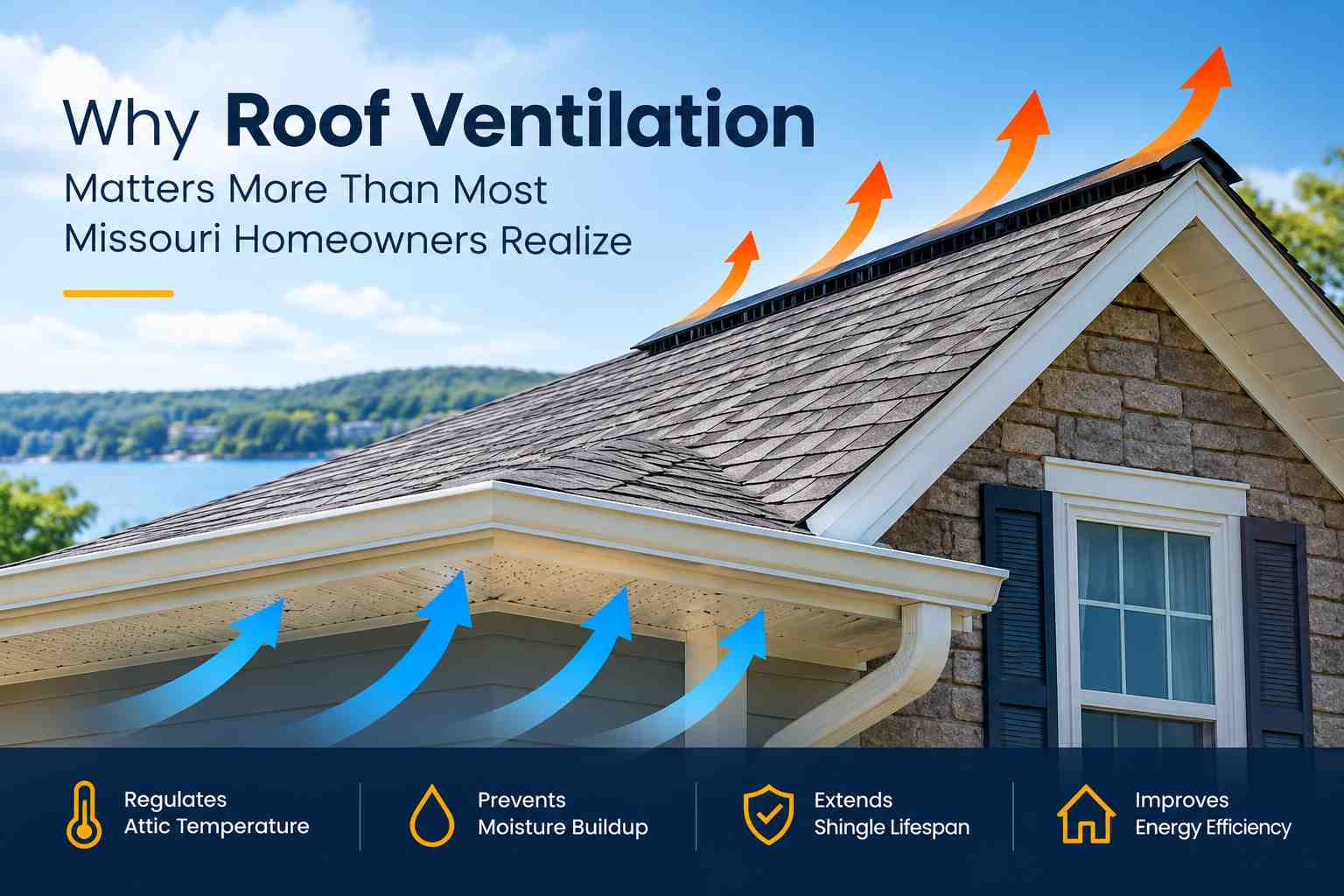
Proper roof ventilation systems control attic heat buildup and moisture. Missouri’s climate is marked by humid, scorching summers and freezing winters, impacting shingle lifespan. Balanced intake and exhaust flow ensures optimal roof performance. Energy-efficient roofing prevents premature shingle wear and failure, ice dams, high energy bills, and costly structural rot. For adequate ventilation, roofing experts recommend combining continuous low soffit vents with high ridge vents to address moisture damage.
Risks of Ignoring Missouri Roofing Ventilation
Extreme Summer Heat Buildup
Surface roof temperatures in Missouri summers can reach between 150℉ and 190℉, which is hotter than the outdoor air temperature, forcing heat downward. Trapped attic temperatures can exceed 130-140℉, baking asphalt from underneath.
Inadequate attic ventilation and airflow cause premature shingle curling, blistering, cracks, and split shingles, ruining them from below.
Mold and Mildew Proliferation
Everyday household humidity moves into the attic. Unchecked moisture creates ideal breeding conditions for toxic mold and mildew, which compromises indoor air quality and causes rot and a sagging deck.
Winter Condensation and Rot
Warm, humid air rising into the attic during Missouri winters condenses on cool wood framing, destroying structural rafters and leading to costly roof repairs.
Ice Dam Formation
Escaping attic heat melts snow on the roof, which refreezes at the roof eaves, creating ice dams. This forces moisture under shingles, causing leaks under the roofline and into the home.
Higher Energy Costs
Trapped heat radiates into living spaces and strains your HVAC, spiking energy bills and increasing component wear. This drives up electricity costs by 10% to 20%.
Voided Warranties
Most major shingle manufacturers strictly require balanced passive ventilation. Ignoring these instructions can void material warranties.
| Under standard building codes and guidelines used across Missouri (The International Residential Code or IRC), the baseline requirement is 1 square foot of net free ventilation area (NFVA) for every 150 square feet of attic floor space. |
Poorly Ventilated vs Ventilated Roofs
| Features | Poorly ventilated Roofs | Ventilated Roofs(Balanced soffit and ridge) |
| Peak summer attic temperature | 140℉ to 160℉ + | 110℉ to 125℉ (15℉ to 30℉). |
| Winter attic moisture level | High with trapped condensation and frost. | Low with continuous flushing of water vapor. |
| Average shingle lifespan | Reduced by 20% to 50% (10-15 years). | Full manufacturer rating (20-25+ years). |
| Cooling energy penalty | Increase AC load by 10% to 15%. | Baseline efficiency maintained. |
| Risk of ice dam formation | High (roof deck warms and melts snow unevenly). | Low (roof deck stays uniformly cold). |
| Mold and deck rot potential | High (active risk within 2-5 years). | Negligible (dry structural framework). |
Signs of Poor Roof Ventilation
- Premature shingle aging
- Ice dams in winter
- Wavy or sagging rooflines
- Mold, mildew, and rust
- Musty odors
- Spike in energy bills
- Upstairs rooms feel overly hot and stuffy during summer
| Balanced attic ventilation continuously flushes out roughly 4.5 gallons of daily moisture generated by household tasks before it can cause deck rot or mold. |
Types of Roof Ventilation: Intake and Exhaust
A balanced 50/50 split between intake and exhaust vents prevents mold. Proper roof ventilation installation
ensures better indoor air quality, roof moisture prevention, and extends roof life.
Intake Vents
Intake vents are placed at the lowest part of the roof structure and pull cool, fresh outside air in at the low eaves.
- Soffit vents are the most common choice for continuous airflow and are installed under roof overhangs.
- Drip edge vents are built directly into the metal flashing at the roof edge. These are used when homes lack adequate soffit overhangs.
- Over fascia vents are placed right above the fascia board to channel air under the roof covering on zero-overhang designs.
Exhaust Vents
Exhaust vents sit near or at the ridge line and push hot, humid air out at the high peak.
- Ridge vents installed along the entire peak of the roof provide a seamless, high-efficiency, continuous exhaust outlet.
- Box vents or turtle vents are small, low-profile square units placed over holes cut near the upper portion of the roof.
- Turbine vents or whirlybirds are the wind-driven rotating fins that generate mechanical suction to pull stale air outward.
- Power or solar vents actively push out extreme heat and humidity when triggered.
- Do not combine ridge vents with powered roof fans or box vents, as this short-circuits proper airflow paths.
Shingles vs Metal Roof Ventilation
| Ventilation Features | Ventilation for Asphalt Shingles | Ventilation for Metal Roofs |
| Primary goal | Removes trapped attic heat and humidity. | Prevents underside condensation and blocks radiant heat. |
| Standard vents used | Ridge, soffit, box or gable vents. | Ridge and continuous soffit vents and specialized closures. |
| Specialized air gaps | Rarely used as shingles lay flat on the underlayment and wood deck. | Often uses Above-Sheathing Ventilation (ASV) via battens or spacer mats. |
| Condensation risks | Lower. Moisture rarely condenses directly on shingle underside. | Higher. Drastic temperature swings can trap moisture beneath bare metal. |
| Thermal performance | Relies entirely on internal attic air exchange and insulation. | Uses the ASV air gap as a thermal break before heat reaches the deck. |
Why Missouri Roofs are More Susceptible to Damage?
Missouri experiences a humid continental climate. Commercial and residential Roofing are susceptible to damage due to
- Extreme seasonal temperatures
- Severe storms with high winds
- Heavy hail
- High humidity
Roof Ventilation Benefits
- Reduces the strain on HVAC
- Extends shingles life
- Keeps attic temperatures close to outdoor ambient levels, preventing ice dams.
Conclusion
Better ventilation releases summer heat and prevents winter condensation. Balanced airflow reduces risk of mold and rot, maintains structural integrity, and maximizes the lifespan of your Missouri roof.
Roof Lux is a licensed and locally owned roofing service with a GAF partnership. Offering manufacturer-specific installation standards on every project, we ensure your roof performs exactly as it is designed to.
FAQs
Will good roof ventilation lower energy bills?
Can I mix and match different types of exhaust vents?
Can bad ventilation void my roof warranty?